


Koa Cloud Forest Conservancy
Active Ecological Restoration in Hawai'i
A living cloud forest ecosystem undergoing active regeneration, documented in real time through direct observation, ecological tracking, and community stewardship

Ecological Stewardship Framework
The Koa Cloud Forest Conservancy (KCFC) manages and studies a native koa (Acacia koa) dominated montane cloud forest system located on Hawaiʻi Island, at approximately 4,500 feet elevation. The site is situated on an older basaltic lava flow characterized by heterogeneous soil development and steep microtopography, creating a constrained yet ecologically active environment.
This system exists within a region impacted by Rapid ʻŌhiʻa Death (ROD), habitat fragmentation, and variable moisture regimes. Despite these pressures, ongoing field observations reveal robust regenerative capacity and the continued function of complex ecological processes across higher trophic levels. Documented responses following Kona Low storm, Kona Earthquake, and Hurricane Lala events include rapid Acacia koa seedling and root sucker emergence within compacted and disturbed substrates, suggesting an active and viable soil seed bank. Following the Kona Low, a naturally deposited and established ʻōhiʻa (Metrosideros polymorpha) seedling was documented emerging from a koa stem bifurcation within the mother's decomposing trunk.
The site exhibits concurrent phenological activity, including overlapping flowering and fruiting cycles, persistent fungal presence, and continuous pollinator visitation. Observations of the native Hawaiian hoary bat (‘Ōpeʻapeʻa) and Hawaiian hawk ('Io) indicate utilization across trophic levels, supporting the presence of a structurally and functionally integrated ecosystem.
Fungal communities are widespread and active, with identified taxa including Schizophyllum commune, Auricularia spp., Trametes versicolor, and members of the Geastraceae family. Post-precipitation emergence patterns, moisture-responsive spore dispersal, and evidence of faunal interaction suggest dynamic decomposition processes contributing to nutrient cycling and regeneration.
KCFC is collaborating with Robert S. Schemenauer, Executive Director of FogQuest, to implement a 1 m² standard fog collector based on established fog water collection methodologies. This effort is designed to quantify cloud water interception rates and evaluate the feasibility of contributing to regional drinking water resources within the Kaʻū district.
KCFC employs a model of direct observation, ecological documentation, and adaptive stewardship to monitor system dynamics and inform restoration practices. Current efforts include biodiversity inventory and regeneration tracking, native and endemic species propagation, invasive species mitigation, and preliminary cloud water capture assessment. These activities support the development of a scalable, community-centered conservation model integrating ecological monitoring, restoration, and education.
KCFC operates as a federally recognized 501(c)(3) nonprofit organization supporting long-term ecological stewardship, restoration, research, and community-centered conservation initiatives on Hawaiʻi Island.
A LIVING STORY
Observe First
ORIGIN
WAO LIPO
LOOKING FORWARD
WHY KCFC EXISTS
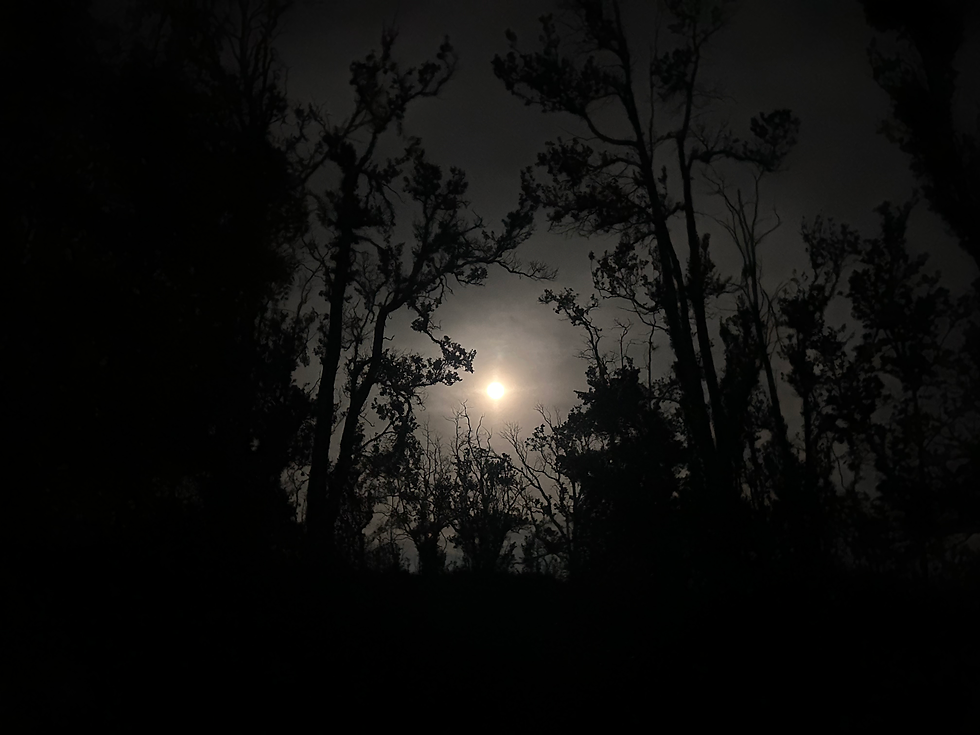
The Hawaiian concept of Wao Lipo speaks of the deep forest, a place of towering trees, shadow, mist, and a profound connection to the otherworldly. It is a reminder that forests are living systems shaped by countless relationships across generations. What exists today is the result of what came before, and what we choose to do now shapes what follows.
Founded by Ka-wai Ola and Joshua Hoaglan, KCFC was created from a shared belief that caring for the land and caring for one another are inseparable responsibilities. Through ecological observation, restoration, education, and community engagement, we seek to support the long-term health of Hawaiʻi's native cloud forest ecosystems while strengthening the human relationships that sustain meaningful stewardship.
Our work is guided by curiosity, gratitude, and a commitment to thinking beyond our own lifetimes. We believe meaningful change often begins quietly: with a seed planted, a conversation shared, or a helping hand offered. These actions accumulate, creating resilience that extends beyond any one person, thing, or event.
As KCFC grows, our vision remains simple. We hope to contribute to a future where native forests flourish, communities remain connected to the places that sustain them, and stewardship is carried forward from one generation to the next.
Mahalo for being part of that story.
Koa Cloud Forest Conservancy began from a shared awareness: interconnectedness is the enduring pattern of all living systems. Separation is often only a matter of scale, distance, or time.
In Hawaiʻi's cloud forests, every act of stewardship becomes part of a larger story. A fallen tree nourishes new seedlings. Fungi transform decay into growth. Clouds gather over distant oceans before returning as rain. Each relationship contributes to the resilience of the whole.
The forest is writing the next chapter.
Steward for Generations
Understand Next

CLOUD FOREST OBSERVATORY
KAʻŪ, HAWAIʻI | ~4,500 FT
JANUARY–SEPTEMBER 2026

MAY 1, 2026 - 9:00 AM | ~4,550 FT
(KCFC)
OBSERVATION
Earthstar fungi (likely Geastrum spp.; family Geastraceae) documented approximately 2 ft below the soil surface, with multiple developmental stages present. Hygroscopic outer rays had reflexed outward, elevating the central spore sac. Multiple fruiting bodies occurred within a localized cluster beneath saturated forest substrate. Morphology indicated readiness for spore dispersal under continued moisture or raindrop disturbance.
ECOLOGICAL SIGNIFICANCE
Reflects active fungal decomposition within saturated subsurface microhabitats. The observed hygroscopic morphology demonstrates moisture-responsive dispersal mechanisms that may enhance spore release under favorable environmental conditions.

AUGUST 28, 2026 - 6:52 PM | ~4,510 FT
(KCFC)
OBSERVATION
Standing dead koa (Acacia koa) monitored through progressive fungal colonization and decomposition. A naturally established ʻōhiʻa (Metrosideros polymorpha) seedling was documented emerging from a stem bifurcation within the decomposing trunk concurrent with koa regeneration. A seed is believed to have been deposited during the Kona low storm and subsequently germinated within organic material retained by the fork.
ECOLOGICAL SIGNIFICANCE
Illustrates how standing dead wood may function as a regeneration substrate for native vegetation. The concurrent presence of koa, ʻōhiʻa, and fungal communities reflects ecological processes that may contribute to long-term forest succession and structural resilience.

MARCH 30, 2026 - 1:25 PM | ~4,500 FT (KCFC)
OBSERVATION
Naturally established koa (Acacia koa) seedling documented within a primary disturbed pathway beneath closed cloud forest canopy. Continued vertical growth continues to be observed following emergence despite persistent low-light conditions. No recent evidence of browse, insect feeding, stem injury, or foliar discoloration was observed at the time of documentation.
ECOLOGICAL SIGNIFICANCE
Demonstrates successful koa establishment within compacted disturbance microsites. Continued vertical growth and leaflet movement are consistent with sustained physiological activity beneath dense native cloud forest canopy.
MAY 1, 2026 — 9:00 AM | ~4,600 FT (KCFC)
OBSERVATION
Earthstar fungi (likely Geastrum spp.; family Geastraceae) identified approximately 2 ft below the soil surface, with multiple developmental stages present. Hygroscopic outer rays had reflexed outward, elevating the central spore sac above saturated soil layers. Specimens appeared positioned for imminent spore dispersal, potentially triggered by continued moisture input or raindrop impact.
INTERPRETATION
Reflects active fungal decomposition and probable mycorrhizal activity within saturated subsurface microhabitats, with hygroscopic dispersal structures responding dynamically to elevated moisture availability.
MARCH 30, 2026 — 1:25 PM | ~4,500 FT (KCFC)
OBSERVATION
Koa (Acacia koa) seedling emerging within a primary disturbed pathway beneath low-light cloud forest canopy conditions. Consistent vertical growth observed following emergence.
INTERPRETATION
Indicates successful koa establishment within compacted pathway soils, with observed phototropic growth and leaflet movement consistent with continued physiological function beneath dense montane cloud forest canopy cover.
MAY 29, 2026 - 5:09 PM | ~4,510 FT
(KCFC)
OBSERVATION
Standing dead koa (Acacia koa) monitored through fungal colonization and progressive wood decomposition. An ʻōhiʻa (Metrosideros polymorpha) seedling was documented emerging from a natural bifurcation within the decomposing parent tree alongside ongoing koa regeneration.
INTERPRETATION
Illustrates how decomposing trees create favorable microhabitats for native species recruitment. The coexistence of koa, ʻōhiʻa, and fungal communities reflects interconnected regeneration processes that support long-term forest resilience.
ECOLOGICAL SPOTLIGHT
SEPTEMBER 2026 | DECOMPOSITION

OBSERVATION
A colony of non-conglobating woodlice, likely Porcellio scaber (Porcellionidae), was documented on a decaying ʻōhiʻa log beneath a mat of Persicaria capitata (pink knotweed) within the conservancy's koa-ʻōhiʻa forest. The tuberculate cuticle and exposed uropods rule out true conglobation, distinguishing it from common rolling pillbugs. Individuals recurred across the site's elevation gradient wherever moisture and decomposition coincided, suggesting a stable population. Identification rests on field photography; genus-level confidence is high, species-level confirmation pending.
ECOLOGICAL SIGNIFICANCE
Terrestrial isopods rank among the forest floor's principal decomposers. By fragmenting deadwood and leaf litter into smaller particles, they expand the surface area available to fungi and bacteria, measurably accelerating the return of nutrients to the soil (van Gestel, Loureiro & Zidar, 2018). Laboratory work on this same species has shown that isopod activity increases bacterial abundance and reshapes microbial community structure within decomposing litter (Špaldoňová & Frouz (2014), a quiet mechanical process that keeps a cloud forest's nutrient cycle in motion long after a log has fallen.
MAY 1, 2026 — 9:00 AM | ~4,600 FT (KCFC)
OBSERVATION
Earthstar fungi (likely Geastrum spp.; family Geastraceae) identified approximately 2 ft below the soil surface, with multiple developmental stages present. Hygroscopic outer rays had reflexed outward, elevating the central spore sac above saturated soil layers. Specimens appeared positioned for imminent spore dispersal, potentially triggered by continued moisture input or raindrop impact.
INTERPRETATION
Reflects active fungal decomposition and probable mycorrhizal activity within saturated subsurface microhabitats, with hygroscopic dispersal structures responding dynamically to elevated moisture availability.
MARCH 30, 2026 — 1:25 PM | ~4,500 FT (KCFC)
OBSERVATION
Koa (Acacia koa) seedling emerging within a primary disturbed pathway beneath low-light cloud forest canopy conditions. Consistent vertical growth observed following emergence.
INTERPRETATION
Indicates successful koa establishment within compacted pathway soils, with observed phototropic growth and leaflet movement consistent with continued physiological function beneath dense montane cloud forest canopy cover.
MAY 29, 2026 - 5:09 PM | ~4,510 FT
(KCFC)
OBSERVATION
Standing dead koa (Acacia koa) monitored through fungal colonization and progressive wood decomposition. An ʻōhiʻa (Metrosideros polymorpha) seedling was documented emerging from a natural bifurcation within the decomposing parent tree alongside ongoing koa regeneration.
INTERPRETATION
Illustrates how decomposing trees create favorable microhabitats for native species recruitment. The coexistence of koa, ʻōhiʻa, and fungal communities reflects interconnected regeneration processes that support long-term forest resilience.

_heif.png)
SEPTEMBER 12, 2026 - 11:20 AM | ~4,550 FT
(KCFC)
OBSERVATION
A segmented, unidentified earthworm was documented reworking a mix of composted bark and dark topsoil roughly one foot below the surface. Numerous unidentified vermicular species have been recorded property-wide, including one family grouping with juveniles. Individuals vary visibly by soil composition, from pale, translucent bodies in mulch-heavy substrate to darker, denser-bodied forms in compacted topsoil. Species-level identification is pending; multiple morphotypes suggest more than one species on site.
ECOLOGICAL SIGNIFICANCE
Earthworms act as ecosystem engineers, physically restructuring soil as they burrow and feed. They produce nutrient-rich castings that make nitrogen and other elements available to plant roots, while their tunnels improve aeration and water infiltration (Darwin, 1881). That constant burrowing turns spent, compacted ground into fresh growing medium below the surface. Earthworm activity in disturbed soil has been linked to measurable gains in plant growth (van Groenigen et al., 2014). Hawaiʻi has no native earthworm species; every worm here descends from an introduced lineage (Strohecker, 2020).
OBSERVATION
Tiny pale specks, suspected Collembola, were documented scattered across decaying koa phyllodes and leaf litter within a patch of decomposing plant matter. Individuals did not spring or hop when touched, the trait most associated with springtails. Many soil and litter dwelling species carry a reduced furcula, the forked jumping organ, and simply cannot jump. Similar white organisms have since been observed property-wide, appearing anywhere decomposition is underway on the land. Order-level identification remains unconfirmed,
ECOLOGICAL SIGNIFICANCE
Where confirmed, Collembola rank among the most abundant soil arthropods on Earth, fragmenting organic matter and grazing fungi into forms more accessible to microbial decomposers (Potapov et al., 2023). Working the surface layer while worms work below, they renew the litter itself, each grazing cycle turning old growth into the raw material of new soil. Densities can reach the tens of thousands per square meter in favorable soils, making confirmed Collembola useful bioindicators of soil health (Rusek, 1998). On this property, isopods, earthworms, and these suspected Collembola have all been documented working the same patches of litter and soil, layering pieces of the same turnover.
SEPTEMBER 24, 2026 - 1:04 PM | ~4,550 FT
(KCFC)
SEPTEMBER 5, 2026 - 9:28 AM | ~4,550 FT
(KCFC)
HELUHELU | FOREST READING
SEPTEMBER 2026 | DECOMPOSITION
Entangled Life: How Fungi Make Our Worlds, Change Our Minds & Shape Our Futures
Merlin Sheldrake | Random House, 2020 | New York Times Bestseller
"A 'brilliant [and] entrancing' (The Guardian) journey into the hidden lives of fungi—the great connectors of the living world—and their astonishing and intimate roles in human life, with the power to heal our bodies, expand our minds, and help us address our most urgent environmental problems."
— Penguin Random House
"Grand and dizzying in how thoroughly it recalibrates our understanding of the natural world." — Ed Yong, author of An Immense World
The fungi and decomposers in this month's Ecological Spotlight are doing the quiet work Sheldrake describes, turning fallen wood and leaf litter into new life for the forest.
Fungi shape Hawaiʻi's forests in both directions. Here on the mauka slopes, they break down fallen koa, māmane, and ʻōhiʻa, returning that life to the soil. Beneath the canopy, ʻaʻaliʻi and ʻōhelo rely on root partnerships with fungi to draw nutrients from young volcanic ground. Two introduced fungi also cause Rapid ʻŌhiʻa Death, a disease now killing ʻōhiʻa across the islands. Understanding the fungal kingdom helps us care for the forest we are working to protect.
Borrow the ebook or audiobook through the Hawaiʻi State Public Library System.

FOREST READING
SEPTEMBER 2026 DECOMPOSITION
Field Programs, Research & Community Engagement
KCFC’s ongoing fieldwork integrates ecological observation, native forest regeneration, watershed monitoring, fungal network documentation, and community-based stewardship within a living montane cloud forest system on Hawaiʻi Island.
Rapid ʻŌhiʻa Death (ROD) Surveillance & Forest Health Monitoring
Current efforts are informed in part through ongoing educational engagement with Dr. J.B. Friday and Hawaiʻi Island ROD outreach initiatives.
Fog Water Capture Feasibility Study
(FogQuest-Aligned)
Evaluation of fog collection systems for cloud water interception and potential community application
(methodologies provided by Robert S. Schemenauer).
Fungal Network & Decomposition Dynamics Monitoring
Documentation of mycorrhizal presence, fungal fruiting cycles, decomposition activity, and post-storm nutrient cycling processes.
Active Projects
Acacia Koa Seedling Establishment & Recruitment Monitoring
Multi-site tracking of natural and assisted regeneration across elevation and microhabitat gradients.
Perimeter Protection & Invasive Species Pressure Mitigation
Infrastructure development and monitoring aimed at reducing ungulate intrusion and invasive species impacts.
Phenology Tracking (Flowering, Fruiting, Growth Cycles)
Time-series observation of plant reproductive cycles, seasonal shifts, and climate-responsive growth patterns.
Onsite Acacia Koa Nursery & Community Distribution Pilot
Small-scale propagation supporting restoration initiatives and future community-based native species dispersal.
Baseline Biodiversity Inventory & Ecological Documentation
Systematic cataloging of flora, fungi, avian activity, and ecological interactions to establish a long-term observational dataset.
Pay It Forward Initiative - Community Tea Basket
A community stewardship project featuring locally sourced teas, books, and music shared through a pass-it-forward model that encourages connection, reciprocity, and community resilience.
Recognition, Resources & Trusted Partners
Koa Cloud Forest Conservancy is grateful for the organizations, agencies, and community partners whose support strengthens our ability to protect Hawaiʻi's native cloud forests. These relationships expand our capacity, improve transparency, and increase the resources available to support long-term conservation, education, and stewardship.
Recognition
Organizations formally recognizing or supporting KCFC
Scientific Resources
Agencies and institutions that inform our work.
Community Partners
Individuals and organizations working alongside KCFC.
Contact
Hawai'i Conservation Partnerships & Community Stewardship
Tropical montane cloud forests are globally rare, occupying about 0.4% of Earth’s land surface, yet they are disproportionately important to freshwater systems. By capturing moisture directly from passing clouds, their vegetation can add substantial water to forest soils and watersheds, particularly during dry periods.
KCFC is supported through a growing network of nonprofit partners, conservation collaborators, technical advisors, workplace giving programs, and community volunteers helping protect and restore Hawaiʻi's native cloud forest ecosystems for future generations.
Contributions at this stage directly support:
• Long-term ecological observation and cloud forest monitoring
• Cloud physics initiatives (fog collector sites aligned with FogQuest)
• Acacia koa seedling dispersal programs
• Native and endemic species propagation programs
If you feel aligned with this work and would like to contribute, collaborate, or learn more, please contact info@koacloudforest.org.
With deep gratitude, we recognize the contributions of Sasha Knowles of Kailua-Kona, Hawaiʻi; Yukiko Northon of Kailua-Kona, Hawaiʻi; Sifu Chee Johnson of Kealakekua, Hawaiʻi; Hayden Stephens of Kailua-Kona, Hawaiʻi; Cindy of Waimea, Hawaiʻi; Elaine Albertson of Kailua-Kona, Hawaiʻi; Unity of Kona of Kailua-Kona, Hawaiʻi; Anna and Roger Southern of Waimea, Hawaiʻi; Erin J. of Ocean View, Hawaiʻi; Auntie Janut and Larry of Ocean View, Hawaiʻi; James and Ohana of Captain Cook, Hawaiʻi; Gale Ziccareli of Kailua-Kona, Hawaiʻi; Robert S. Schemenauer of British Columbia; Dr. JB Friday of Hawaiʻi Island; Dr. Mark S. Thorne of Kamuela, Hawaiʻi; Dr. Mark Wright of Kailua-Kona, Hawaiʻi; Angelina and Keali'i of Ocean View, Hawaiʻi; and Diana Hoaglan-Blair and Steve Blair of Collierville, Tennessee.
KCFC also honors the aviation and artistic legacy of the late Gale Duane Hoaglan, whose pointillist artistry inspired the imagery and visual character featured throughout this website.
He Waʻa He Moku, He Moku He Waʻa
"The canoe is an island, and the island is a canoe."
E Ola Koa
"Live like a koa tree."